
Afterflow
On life after a crossing

“A threshold is not a simple boundary; it is a frontier that divides two different territories, rhythms, and atmospheres. It is a lovely testimony to the fullness and integrity of an experience that it intensifies toward the end into a real frontier that cannot be crossed without the heart being passionately engaged and woken up.”
— John O’Donohue
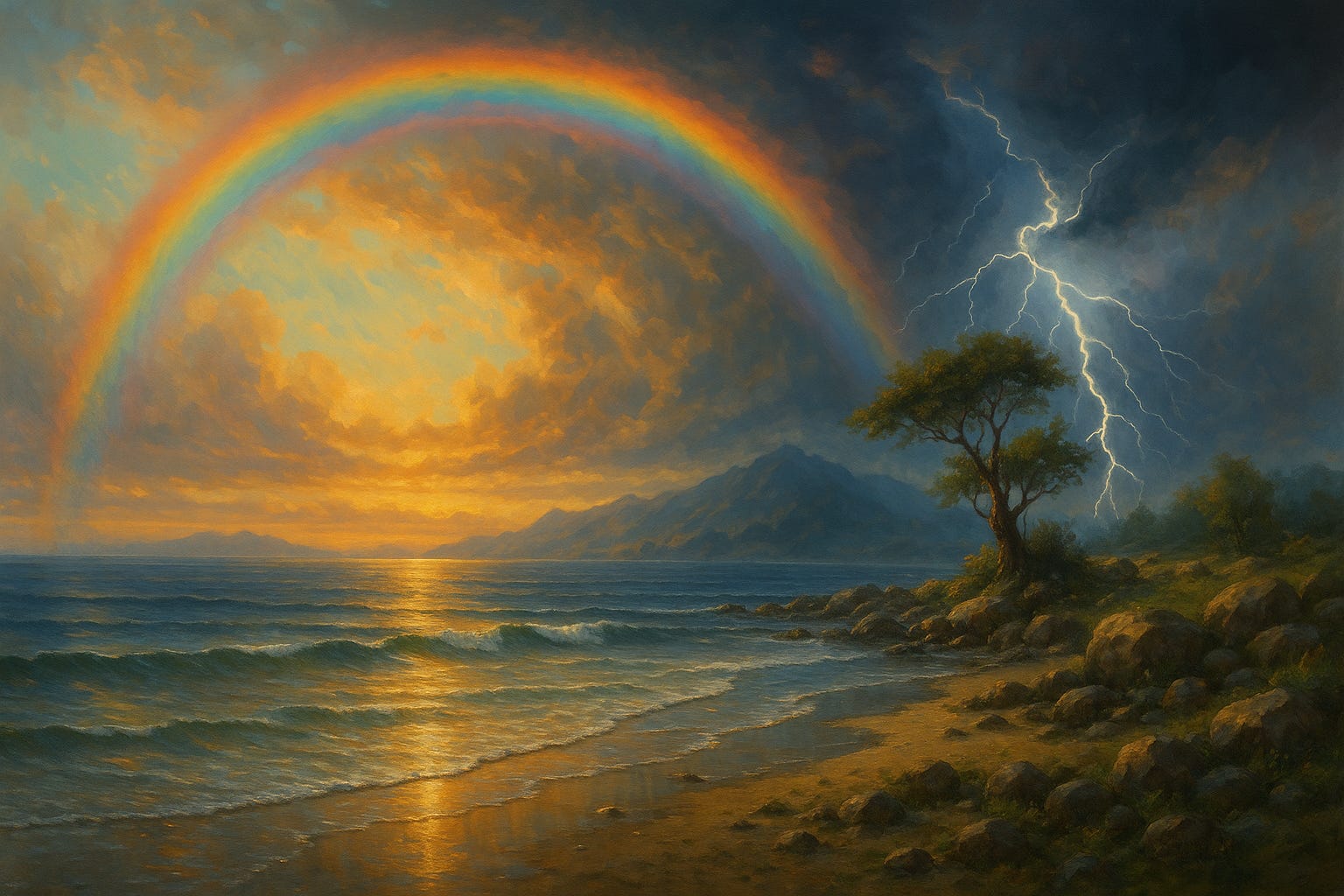
Arriving on a New Shore
In two weeks, I met four babies: my twin brother’s son and the children of three close friends. Each home held some version of the same scene—bassinets and baby books, tender chaos, sleepless eyes. It felt like a shoreline after a storm: the ground still trembling from what it had survived, but now shimmering with the fragile calm of new beginning.
Holding my nephew for the first time, I could feel the crossing written all over my brother and his wife. Birth leaves its mark. It is a threshold that asks for something on the way in and offers something irrevocable on the way out. There is no going back—not as the same person. Not fully.1
I realized I’d crossed my own rivers too. The book I’m writing has carried me through its own flood—reshaping me as much as I shaped it. Illness has humbled me. Heartbreak has reset me. Identity itself has been a river I keep wading into, washing away what no longer fits so something truer can take form.
Each crossing leaves a tide line. Some currents carry joy, some rupture. Some landings anchor you; others leave you gasping on the bank, unsure who you are without what you’ve lost. In each case, the river didn’t just move me forward—it altered the vessel that carried me. But too often, I’d step back into it as though it was still the same.
Settling on the Sand
Despite how deeply those currents shaped me, I never paused long enough to let their wisdom take root.
Every time I arrived on a new shore, I was already halfway onto the next boat—still dripping from the previous crossing. I didn’t pause to honor what I had lived through, to feel what had ruptured or been reborn. I just kept paddling—into the next love, the next identity, the next crossing.
But this time, something shifted. I didn’t push off. I stayed. I let the water still so I could see beneath the surface—not with a quick glance, but a deep gaze into what I had been too fast or too afraid to face before.
For the first time, I didn’t try to get ahead of the crossing or force the next beginning. I rested at the new shore, letting the ending speak. I learned how to live in the afterflow—the subtle current that remains after the main surge has passed.
And in that stillness, the river finally had room to teach.
Covenant of Color
As my nephew slept on my chest, I read The Life of Pi. Pi survives 227 days at sea with a Bengal tiger named Richard Parker—fear and faith pressed together in one lifeboat. When they finally touch land, Richard Parker leaps out of the boat. Pi calls him “a furred rainbow.”
Across traditions, the rainbow is a bridge: the Bifröst of Norse myth2, the rainbow body of Tibetan teaching3, the Rainbow Bridge near Niagara Falls where enslaved people walked into a new life. Each tells the same truth: what follows devastation is deliverance, and what follows deliverance is light.
A rainbow is what’s left after the flood, the final bridge to shore. It’s the full spectrum of emotion refracted into something visible: grief, awe, weariness, joy, relief, despair, and wonder—all held at once. The light breaking through is made of every feeling we carried through the water.
Like Noah’s covenant, rainbows have followed many of my own crossings—after heartbreak, healing, and creative labor. They appear as living reminders that what I endured was not for nothing. That what broke me could also bless me.
The promise isn’t that deep water won’t return—but that each flood can refine rather than ruin, if we stop and integrate on the shore.
As Kacey Musgraves sings, “There’s always been a rainbow hanging over your head.” We just have to stop long enough to look up.
The Light that Breaks
But the rainbow is never the end of the story. Because right after the rainbow, lightning strikes.
For Pi, lightning didn’t arrive as a bolt from the sky, but as Richard Parker’s sudden disappearance. The companion who helped him survive the storm disappeared into the jungle without a backwards glance. That’s the paradox of arrival: not everything that carries us through can cross with us into what’s next.
I saw it in my own life too: the relationships that didn’t make it to the other side. The identities that dissolved. The coping patterns that once kept me afloat but now felt too cramped.
The rainbow is remembrance—the promise that we are held. The lightning is grace—the flash that reveals what we’ve outgrown.
When Jesus rose from the baptismal waters, he was immediately led into the wilderness. Deliverance wasn’t the finish line, but the entry point into deeper transformation. Lightning before peace. Revelation before rest.
Mae from Ted Lasso put it this way:
“When you make it to the summit, what’s left for you but lightning?”
“Is lightning a good thing or a bad thing?” Keely asks.
“It depends if you’re ready for it or not.”
Lightning shatters what’s false to reveal what’s true. If we cling, it feels like loss. If we surrender, it feels like liberation. Apocalypse, after all, means unveiling—not the end of the world, but the end of illusion.
Grounding after the Strike
During a wilderness training, I once played the victim of a lightning strike. I had to lie still while others decided how to carry me. I couldn’t move. I had to be held. Lightning forced me into stillness—and into trust.
In a real strike, survival depends on stance. With both feet planted, the current can travel through you—entering and leaving—without bursting what’s within. The key is letting something beyond your own body absorb what you cannot hold.
It’s the same with grief, exhaustion, or revelation.
I saw this in my brother and his wife: one holding the baby, one resting, each honoring what the other needed. That shared structure of support mirrored something deeper—the earth holding us up, the sky blessing us, the water washing away what no longer serves.
When Joshua led his people across the Jordan River, he didn’t step into ease but into humility and a land of giants. The Promised Land—Canaan—literally means “lowland” or “a humble place.” Arrival wasn’t triumph, but grounding.
That’s when it clicked for me. The giant I needed to face wasn’t a person, but a pattern: the belief that I had to carry everything, to outrun the quiet, to pretend strength was enough.
Lightning illuminated the truth: grace doesn’t break us to punish—it breaks us to connect.
Flowing Forward
Only after the stillness did a deeper voice rise from within the silence:
Stop.
Check your speed.
What direction are you going?
And in which vessel?
I finally saw how often life had invited me into the same crossing wearing different names: new city, same burnout. New partner, same pattern. New season, same self. It wasn’t that I wasn’t changing—it was that I was moving faster than I was integrating.
Then came the question that shifted it all:
What if the vessel that got you here isn’t the one meant to take you forward?
That was the turning point. Not because the water changed—but because I finally did.
It wasn’t about abandoning the past but about realizing I wasn’t meant to travel the river in the same way. I didn’t just need resilience—I needed resonance. I didn’t need a stronger hull—I needed a different relationship with the water.
The lightning cracked open the vessel of self-reliance I’d sealed myself inside. It revealed what was always true: the water, the love, the grief, were meant to move through me—not be held by me. We are meant to be conduits, not containers.
Now I know: I must let support become part of the structure. I must let myself be held. I must rebuild with others—the earth, the heavens, those around me.
Healing isn’t an invitation to repeat what was. It’s a call to reorient. Not to pull away from the river, but to move in rhythm with new terrain and deeper currents.
Deeper Currents
Lightning may break us open, but only embodied change keeps us from being struck in the same way again.
Once the illusion falls away, we’re offered the invitation to paddle differently and to build a new boat.
There’s a reason Jesus instructed the blind man who regained his sight not to go back to the village he came from. Vision doesn’t just change what we see—it changes how we live and move. Or as John O’Donohue put it:
“Having crossed the threshold into vision, his life was no longer to be lived in the constricted mode of blindness; new vision meant new pastures.”
Life kept inviting me to turn lesson into wisdom, rather than repetition.
Integration is prevention. It’s how we honor the crossing—by refusing to re-enter vessels that nearly drowned us. It’s the afterflow that guides us toward new shores, new patterns, new ways of being.
Not all crossings are meant to be avoided. Some are renewals—second births, new loves, creative resurrections. But they unfold differently only when we move differently.
So before I begin another crossing, I ask:
What have I learned?
What must I leave?
What is mine to carry now?
Because if I want the river to move me toward life, I must live what it taught.
The Shore of Grace
I am grateful—not just for arriving, but for everything that carried me here.
There were moments when the current could’ve taken me, when the night swallowed hope, when loss seemed final. And yet something greater than my own strength carried me through.
I bless everyone who walked beside me, even if only for a stretch. Some relationships dissolved before the rainbow. Others vanished under the lightning. But each one did exactly what it came to do: awaken what was still asleep in me—reveal where love needed more room.
As Pi said of Richard Parker, the only thing left to say was thank you.
Because gratitude is what turns survival into illumination, endings into beginnings. The end of a crossing is never the end of love—just its transformation. Because love, like the current, never simply ends. It circles back. Like Pi—the number that spirals on.
After the stillness on the shore, something subtle begins to happen. Not because we paddle or push, but because the current itself knows when it’s time to move again. The same power that carried us through the flood now returns in new form: as the unseen energy that reconnects us, recharges us, and invites us back into motion.
The Returning Current
The return current—from human to heaven—is where the power is strongest. It’s the visible strike of lightning in the sky. Lightning doesn’t just destroy—it reunites heaven and earth.
It’s no accident that lightning seeks water. The more we align ourselves with the Living Water, the more easily grace finds us. Not by striving, but by becoming the clearest path for it to flow.
Maybe that’s why Pi’s name in Chinese also means grace—the unseen current beneath every crossing. The kind that carries us when our own strength fails. The kind that asks nothing but trust.
And now, on a new shore, I trust that the companions meant for this season will recognize me in their own time. We’ll meet by the quiet water—unrushed, unbroken, unafraid.
So I stand a little longer. Feel the ground beneath my feet. Breathe. Give thanks for every river and every rising. Not because it was easy, or fair, or without loss—but because it was real. And it changed me.
The covenant still holds. There has always been a rainbow overhead.
And like Taylor Swift, I’ve finally learned to dance through the lightning strikes.4 Even now, I can feel the sky turning opalite: pure, peaceful, and promise-filled.
P.S. my brother Anarchist Therapy Productions wrote a song called No Maps to the Promised Land that feels like the soundtrack of this journey—an anthem for those crossing without a map, guided by heart, humility, and the quiet pulse of something deeper. You can listen here (or on Spotify): soundcloud.com/tor-syvrud/no-maps-to-the-promised-land
Thanks for reading My Waterful Life!
My nephew’s birth was an exceptionally difficult one. My brother shares about this crossing in his essay and new song called Still Breathing at the Bottom.
Love this one. Hittin' deep.
Bravo, Amy! You've obviously spent a lot of introspective time analyzing the flow of your life voyage to date. I wish you God's speed on your continuing journey.